Guide
How to build an emergency fund, even a small one
3 min read · Beginner

A goal with a price and a deadline is far easier to save for. Learn a simple formula to turn any education goal into a monthly amount, and keep going when you fall behind.
"I want to save more" is a wish. "I will save $600 for a laptop by June" is a plan. Goals with a clear amount and date are easier to reach, because you know exactly what to do each month and can see your progress.
For students, many of the most important goals are linked to education: a laptop, language test fees, university application fees, document translations, or a flight to start your course.
Find out what the goal will actually cost. For fees, use the official source: the test provider's website, the university's application page, the embassy or visa website. Prices change, so write down the date you checked.
Add a small margin for price changes or extra costs, such as a laptop case or the cost of travelling to a test centre.
When do you need the money? For test and application fees, work back from the application deadline. Leave time for the payment to go through, and for a resit if you might need one.
Use this formula:
Worked example (illustrative): you want a $600 laptop in 8 months and have already saved $120. You need ($600 − $120) ÷ 8 = $60 a month.
If that amount does not fit your budget, you have three choices: save for longer, lower the target (a good refurbished laptop, for example), or find extra income.
Keep goal savings separate from your spending money and from your emergency fund. A separate wallet, account or even a labelled envelope makes the goal real, and makes it harder to spend the money by accident.
Move your monthly amount as soon as money arrives. Then check your progress once a month. Seeing the gap shrink is one of the best reasons to keep going.
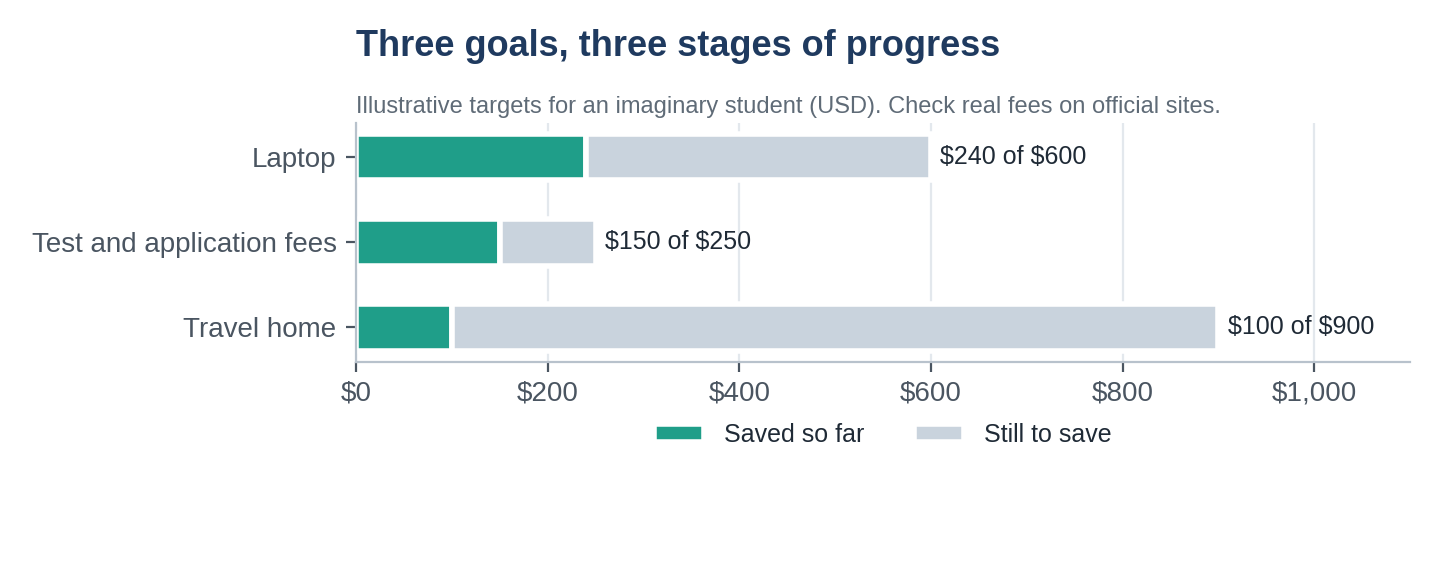
In this imaginary example, the student is close to the test and application fees, has made good progress on the laptop, and has barely started on travel home. Seeing all three together helps decide where the next dollar should go.
Most people do. Put them in order:
You can save for several goals at once by splitting your monthly amount. Just make sure the total fits your budget.
It happens. A month with an emergency or a late payment does not mean the goal has failed. Recalculate using the formula: the new monthly amount, or a new deadline, will show you what is realistic now.
Some universities, test providers and programmes offer fee waivers, reduced fees or free alternatives for some applicants. Always check the official website or ask whether any reduction is available before you pay. It could shorten your savings goal considerably.
| Goal | Amount (USD) | Source and date checked | Deadline | Already saved | Months left | Monthly amount |
|---|---|---|---|---|---|---|
| Example: Laptop | 600 | Shop price, 1 Oct | June | 120 | 8 | 60 |
Choose one goal. Look up its real price, set a deadline and use the formula to calculate your monthly amount. Make your first transfer into a separate place this week.
This article gives general guidance and contains no time-sensitive facts, rules or prices, so no external sources are cited. All figures are illustrative.