Hagbad and other savings groups: how to use them well
Rotating savings groups such as hagbad help many families save and access lump sums without interest. Learn how they work, where the risks lie, and how a written agreement protects everyone.
Written and reviewed by the Fursad Connect editorial team
Long before mobile apps and savings accounts, communities found their own ways to save together. One of the best known among Somalis is the hagbad, also called ayuuto. Similar groups exist all over the world, under many names. Economists call them rotating savings and credit associations.
They remain popular because they work: they build a saving habit, give members access to a useful lump sum and involve no interest. Like any money arrangement, though, they work best with clear rules.
How a hagbad works
A group of people agree to pay a fixed amount at regular intervals, often every month. Each time, one member receives the whole amount collected, called the pot. The rotation continues until every member has received the pot once.
Month
Everyone pays
Pot
Who receives it
1
$50 each × 5
$250
Member A
2
$50 each × 5
$250
Member B
3
$50 each × 5
$250
Member C
4
$50 each × 5
$250
Member D
5
$50 each × 5
$250
Member E
Illustrative figures.
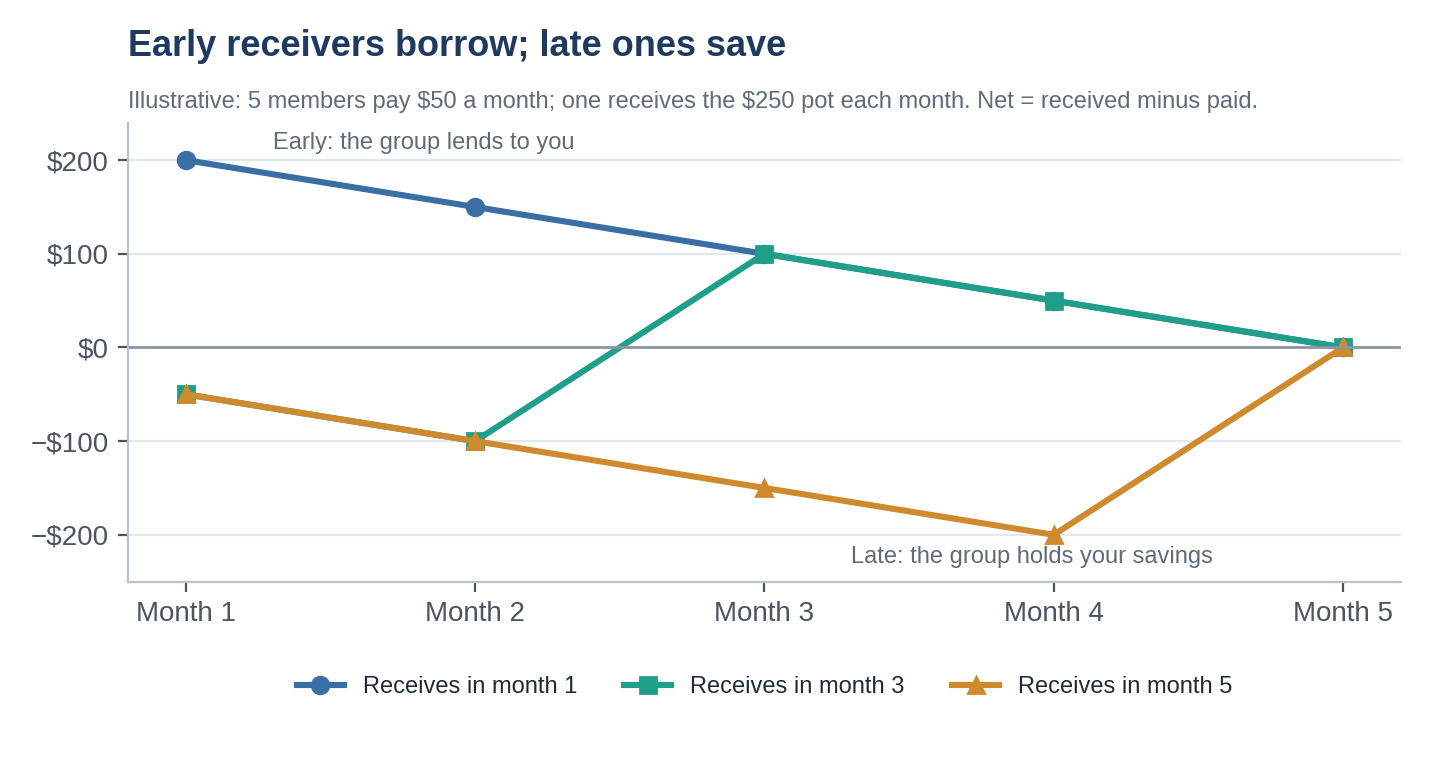
By the end, everyone has paid $250 and received $250. Nobody gains or loses money. What changes is when you have it.
If you receive early, you get the lump sum before you have paid for it. In effect, the group lends you money, and you repay it through your later contributions.
If you receive late, you pay in first and receive at the end. In effect, you are saving, and the group holds your savings.
Both are useful. But understand which one you are doing. An early receiver who stops paying leaves the others with a loss. A late receiver depends on everyone else continuing to pay.
Why people use savings groups
Discipline. A fixed contribution to people you know makes saving hard to skip.
A useful lump sum for school fees, a business, a wedding or a deposit.
No interest, which many members value for religious reasons.
Trust and community. Money stays within a group that knows each other.
Where the risks lie
A member stops paying, especially after they have received the pot.
Disputes about the order, or about changing it when someone has an emergency.
Lost or unrecorded payments, particularly with cash.
An organiser who mishandles the money, even by accident.
Little formal protection. In most places, an informal group has no regulator or guarantee scheme to step in if something goes wrong.
Over-commitment. Joining a group whose contribution doesn't fit your budget.
How to use a savings group well
Join people you trust, and who can realistically afford the contribution.
Make sure the contribution fits your budget. Treat it as a fixed cost in your monthly budget.
Agree the order fairly and openly: by drawing lots, by agreement, or by need. Write it down.
Use traceable payments. Paying by mobile money or bank transfer creates a record.
Keep a shared record of every payment and every pot, which all members can see.
Write a simple agreement before the first payment (see below).
Plan how you will use your pot before you receive it, so it goes to the goal you joined for.
Template: a simple group agreement
Agree and write down:
Members' names and contact details.
The contribution amount and how often it is paid.
The payment date, and how payments are made.
Who organises the group, and how records are kept and shared.
The order in which members receive the pot, and how it was decided.
What happens if someone pays late or misses a payment.
Whether, and how, members can swap places in an emergency.
What happens if someone needs to leave the group.
How disagreements will be settled.
Each member should keep a copy.
Your next step
If you are in a savings group, suggest the group writes down its rules using the template above, and agrees on a shared record of payments. If you are thinking of joining one, check that the contribution fits your budget first.
Sources
This article explains a long-standing community practice and contains no time-sensitive facts, rules or figures, so no external sources are cited. All figures are illustrative.
General information only. This guide is written to help you plan and learn. It is not personal financial, legal or tax advice, and Fursad Connect does not recommend specific financial products. Check details with your bank, university or a qualified adviser before you make decisions.