GuideBeginner4 min read

What a scholarship really pays for, and the gap it can leave

"Fully funded" does not always mean every cost is paid. Learn to read an award line by line, spot the costs it leaves out, and work out how much you still need to find.

Winning a scholarship is a great achievement. But the headline can hide important details. Two awards that both sound generous can leave you with very different costs to cover. Before you accept an offer, or even before you apply, it pays to know exactly what the money is for.

"Fully funded" means different things

There is no single official meaning of fully funded. Some awards pay tuition, living costs and flights. Others pay tuition and a living allowance, but not your visa or health charges. A few pay tuition only and still call themselves fully funded.

So treat "fully funded" as a description, not a promise. The real answer is always in the award's terms and conditions.

The costs of studying, line by line

Most study costs fall into these groups:

  • Tuition fees: what the university charges for your course. An award may pay these in full, in part, or as a fee waiver (the university reduces the fee rather than paying you).
  • Living costs: housing, food, transport and daily needs. Awards often cover these through a stipend, a regular living allowance.
  • Travel: flights at the start and end of your course.
  • Visa and health charges: application fees, required medical tests and any health surcharge set by the destination country.
  • Insurance: health or travel insurance where it is required or advisable.
  • Arrival and setting-up costs: a housing deposit, bedding, a winter coat, a laptop.
  • Family costs: if you plan to bring a spouse or children, their travel, visas and living costs.

How to read an award's terms

Find the award's official terms and conditions, not a summary on a listing site. Then read slowly and look for these words:

  • "Up to" means a maximum, not a guarantee.
  • "A contribution towards" means part of a cost, not all of it.
  • "One-off" or "lump sum" means paid once, not every month.
  • "Reimbursed" means you pay first and claim the money back later. You need that money available up front.
  • "Dependants not covered" means your family's costs are yours.

Compare two awards side by side

Here is an imaginary first year costing $29,000 in total, and two imaginary awards.

Cost (illustrative)Total costAward A paysAward B pays
Tuition$18,000$18,000$9,000 (50%)
Living costs (12 months)$8,400$8,400 stipendNothing
Return flights$900$900Nothing
Visa and health charges$1,000NothingNothing
Insurance$300NothingNothing
Arrival and setting up$400$400 one-offNothing
You still need to find$1,300$20,000
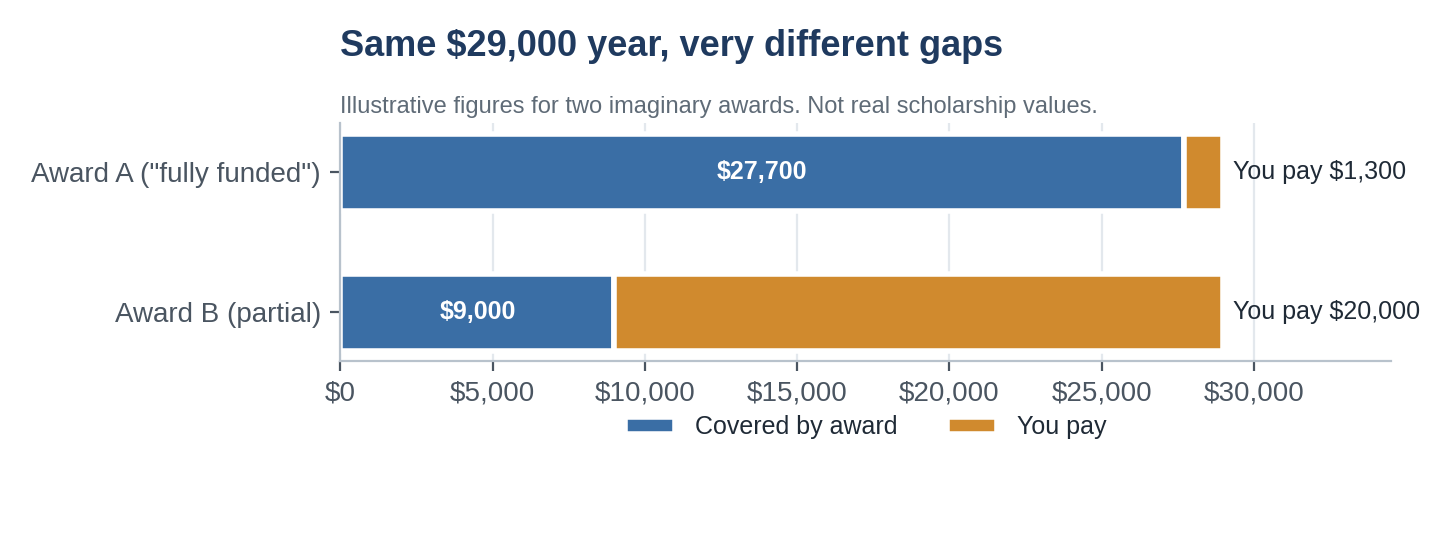
Bar chart comparing two imaginary awards for a $29,000 year: Award A, described as fully funded, covers $27,700 and leaves you paying $1,300; Award B, partial, covers $9,000 and leaves you paying $20,000. Illustrative figures.
Illustrative example: two imaginary awards, USD.

Award A describes itself as fully funded and covers most costs, but still leaves $1,300 to find, much of it before you travel. Award B is a valuable 50% tuition award, yet the student would need to find $20,000 more. Both could be good offers. Only one may be affordable.

Timing matters as much as amounts

Even when an award covers a cost, the money may not arrive when you need it.

  • Before you travel, you may pay visa fees, medical tests, flights and a housing deposit.
  • Many stipends start after you arrive and register, so you may need money for your first weeks.
  • Some countries ask for proof of funds as part of a visa application: evidence that you have enough money for your fees and living costs. Check whether an official award letter counts towards this for your destination, or whether you need to show savings as well.

Conditions that come with the money

Awards often have conditions. Common examples include studying full time, keeping satisfactory grades, not taking certain paid work, or returning to your home country after your studies. Some awards ask you to repay money if you withdraw. Read these conditions before you accept, and make sure you can keep to them.

Checklist: questions to ask about any award

  • Where are the official terms and conditions, and have I read them in full?
  • Which costs does it pay in full, which in part, and which not at all?
  • Is the living allowance paid monthly, termly or once, and from when?
  • Does anything have to be paid by me first and claimed back?
  • Does it cover visa, health charges, insurance and flights?
  • Does it cover family members, if they are coming?
  • What conditions must I keep to, and what happens if I cannot?
  • After all this, how much do I still need to find, and by when?
Your next step

Pick two awards you are interested in, or one award and your current plan. Copy the comparison table and fill in each line from the official terms. The bottom line is your funding gap. Our guide How to fund your university studies looks at ways to close it.

Sources

This article uses imaginary awards on purpose, so it stays accurate as real schemes change. It contains no time-sensitive facts about named schemes, so no external sources are cited. All figures are illustrative.

General information only. This guide is written to help you plan and learn. It is not personal financial, legal or tax advice, and Fursad Connect does not recommend specific financial products. Check details with your bank, university or a qualified adviser before you make decisions.

More money guides

Scroll to Top