Guide
Needs, wants and priorities: the foundation of every budget
3 min read · Beginner

A budget is a plan for your money, not a punishment. Follow five simple steps to build your first monthly budget, test it for a month and adjust it until it works for you.
A budget is a plan that tells your money where to go before the month begins. It does not mean spending less on everything. It means spending on purpose, so the things that matter most are paid for first.
If you have read our guide to needs, wants and priorities, you already have the hardest part: knowing what matters to you. Now we turn that into numbers.
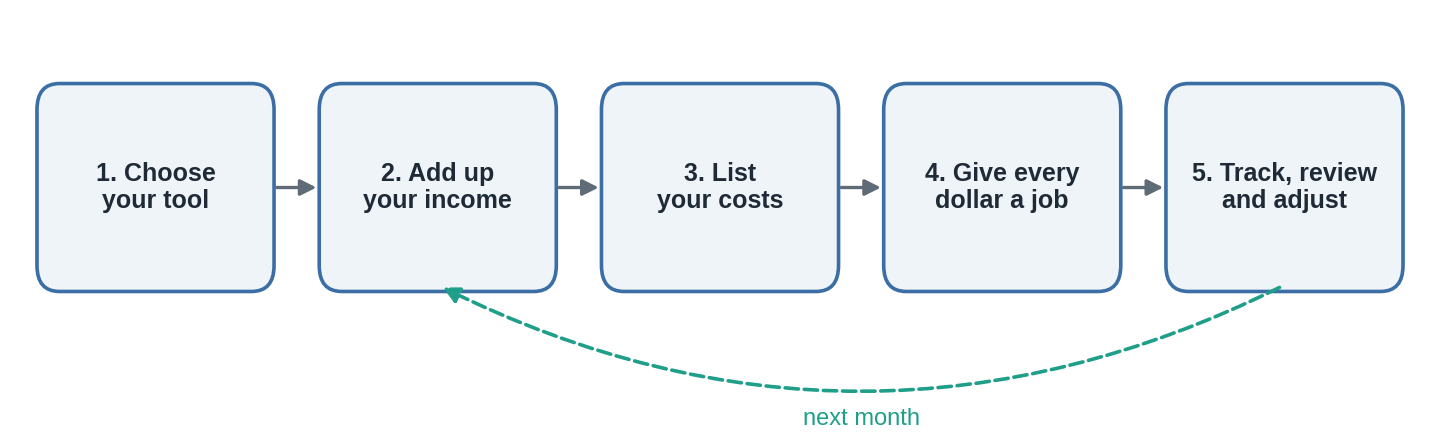
A notebook, a spreadsheet and a budgeting app all work. The best tool is the one you will open every week. If you are not sure, start with a single page in a notebook or a simple spreadsheet.
Write down every amount you expect to receive this month: family support, a scholarship stipend (a regular living allowance), wages or freelance payments.
Two rules keep this honest:
If your money arrives once a term, or at uneven times, our guide to budgeting with an irregular income shows how to turn it into a steady monthly amount.
Sort your costs into three types:
Irregular costs are the ones that break most first budgets. The fix is simple: estimate what they will cost over the year, divide by 12, and set that amount aside every month. Some people call this a sinking fund: a small pot you fill slowly for a cost you know is coming.
Now subtract your costs from your income.
You may have heard of the 50/30/20 approach: 50% of income for needs, 30% for wants and 20% for savings. It is a useful starting point, but it is a rule of thumb, not a rule. In cities where rent is high, needs often take far more than half. Many readers will also want a separate share for giving and family. Adjust the split until it reflects your life.
One habit makes a big difference: pay your savings first. Move your savings amount as soon as money arrives, rather than waiting to see what is left at the end of the month.
A budget is a first guess. At the end of the month, compare what you planned with what you actually spent.
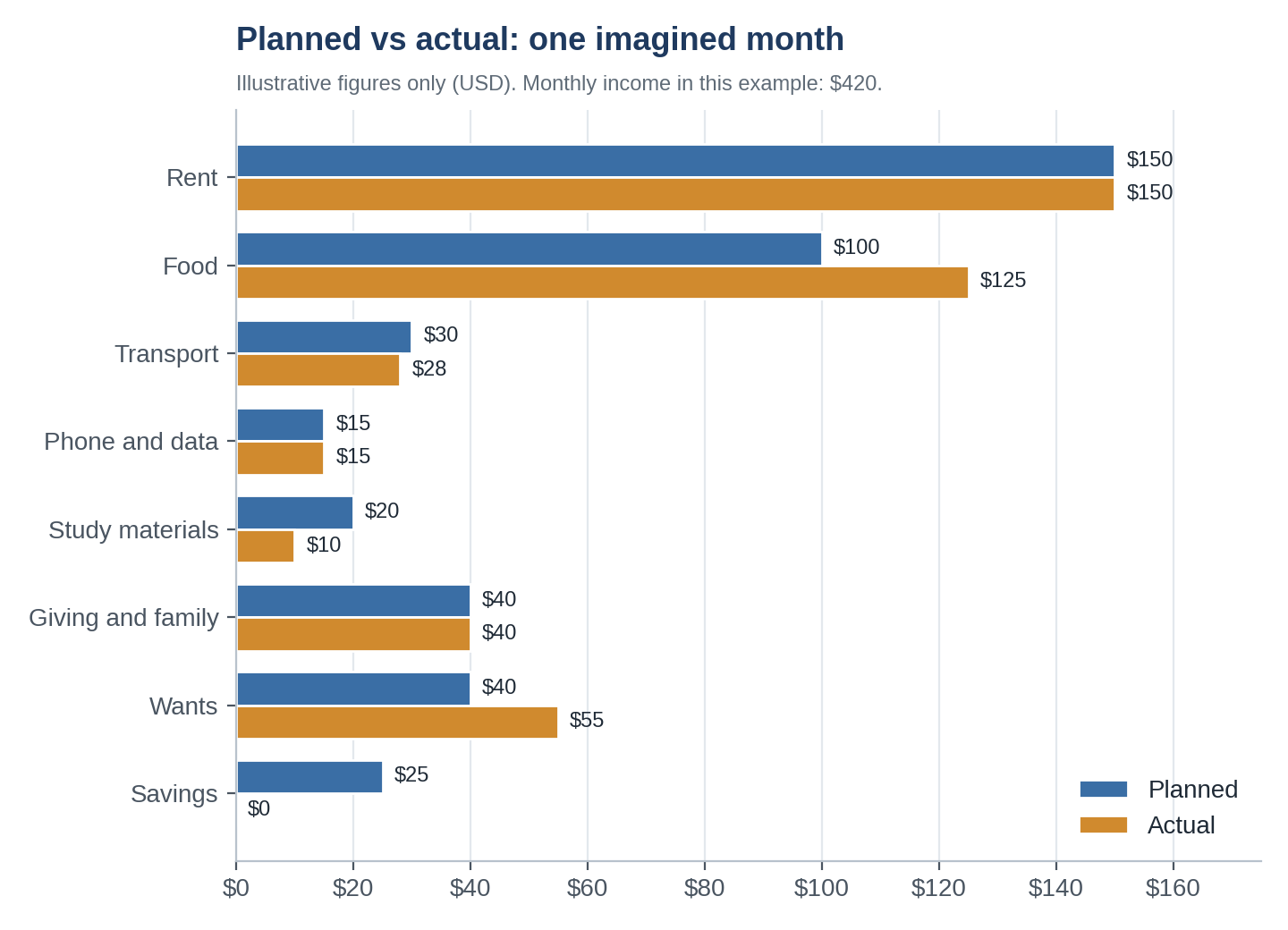
In this imaginary example, rent, phone and giving went exactly to plan. Food and wants went over by $40 in total, so the $25 planned for savings never happened. The lesson is not "try harder". It is to move savings first next month, and to plan a more realistic food amount.
Copy this table into a notebook or spreadsheet. The first row shows the format.
| Category | Type | Planned (USD) | Actual (USD) | Difference |
|---|---|---|---|---|
| Example: Food | Variable | 100 | 125 | −25 |
| Rent | Fixed | |||
| Food | Variable | |||
| Transport | ||||
| Phone and data | ||||
| Study materials | ||||
| Irregular costs (monthly share) | Irregular | |||
| Giving and family | ||||
| Wants | ||||
| Savings | ||||
| Total |
Before next month starts, fill in the Planned column. Move your savings amount as soon as your money arrives. At the end of the month, fill in Actual, compare the two and change one thing for the following month.
This article gives general guidance and contains no time-sensitive facts, rules or figures, so no external sources are cited. The 50/30/20 split is presented as a common rule of thumb, not an official standard. All numbers are illustrative.