Guide
How to build your first monthly budget
4 min read · Beginner

Before you can budget, you need to know what matters most. Learn to separate needs, wants and goals, make honest trade-offs, and build spending priorities that reflect your life and values.
Every budget, however simple, answers one question: what should my money do first? Before you write down a single number, it helps to know the difference between needs, wants and goals. This guide shows you how to sort your spending and make choices you feel comfortable with.
The same item can move between groups. Internet access is a need if your course is online; a faster, more expensive package may be a want. A phone is a need; the latest model usually is not.
When money is short, needs must be protected first. If wants take the money first, you may run out before rent or food is paid. Goals matter too: they are how you move forward, not just get by.
A useful order is:
This is a starting point, not a rule. Many people plan a small amount for wants on purpose, because a budget with no enjoyment in it is hard to keep.
Your priorities are personal. For many Somali students and young professionals, they include responsibilities that general budgeting advice often ignores:
These are not wants to feel guilty about. Treat them as planned priorities, a fourth group called giving and family. Decide what you can give regularly and write it into your plan, rather than paying unexpectedly and running short later.
Look back at last month. Use your mobile money history, bank statement, receipts or memory. Put every payment into one of four groups: need, want, goal, or giving and family.
Here is how one imaginary first-year student's month might look once sorted.
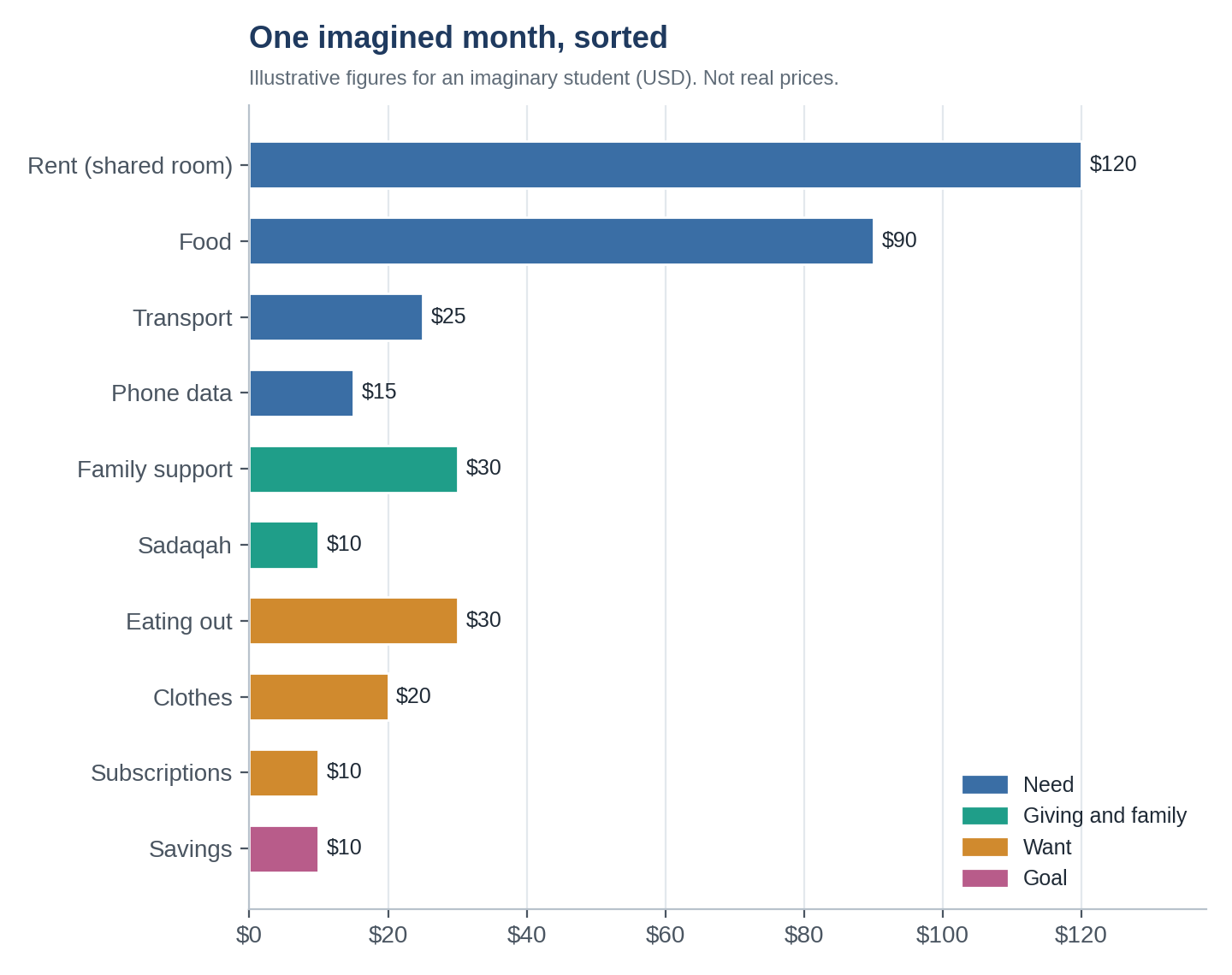
In this example, needs took $250 of $360. Wants took $60, giving and family $40, and goals only $10. Seeing it laid out, the student decided to move $20 a month from eating out into savings.
Sorting is not about cutting everything you enjoy. It is about choosing on purpose. Ask yourself:
Small changes add up. Moving $20 a month into savings becomes $240 over a year.
Some spending feels necessary because of pressure from friends, social media or advertising. Before you call something a need, ask: "What would happen if I waited a month?" If the honest answer is "not much", it is probably a want.
Ask these questions about each payment, in order.
Take last month's spending and sort every payment into the four groups. Add up each group. Then choose one change you are happy to make next month.
Your totals are the starting point for our next guide, How to build your first monthly budget.
This article gives general guidance and contains no time-sensitive facts, rules or figures, so no external sources are cited. All numbers are illustrative.