Guide
How to find scholarships you can actually apply for
5 min read · Beginner

Borrowing can help or hurt, depending on how you do it. Learn how to work out what a loan really costs, read the terms, borrow from family fairly and spot the warning signs of unaffordable debt.
Borrowing means using money now that you must repay later. Used carefully, it can help: spreading the cost of a laptop you need for your course, or covering a short gap until a confirmed payment arrives. Used carelessly, it can follow you for years.
This guide is general education, not personal debt advice. If you are already worried about debt, skip to the section on getting help.
Borrowing may make sense when:
It is usually a warning sign when:
If the gap is regular, the answer is usually in your budget, not in a loan. Our guide to building your first budget can help.
The most important number is not the monthly payment. It is the total amount you will repay. The difference between that total and what you borrowed is the cost of borrowing: interest plus any fees.
Where lenders are required to show it, the APR (annual percentage rate) helps you compare the yearly cost of different loans, including most fees. A higher APR means a more expensive loan.
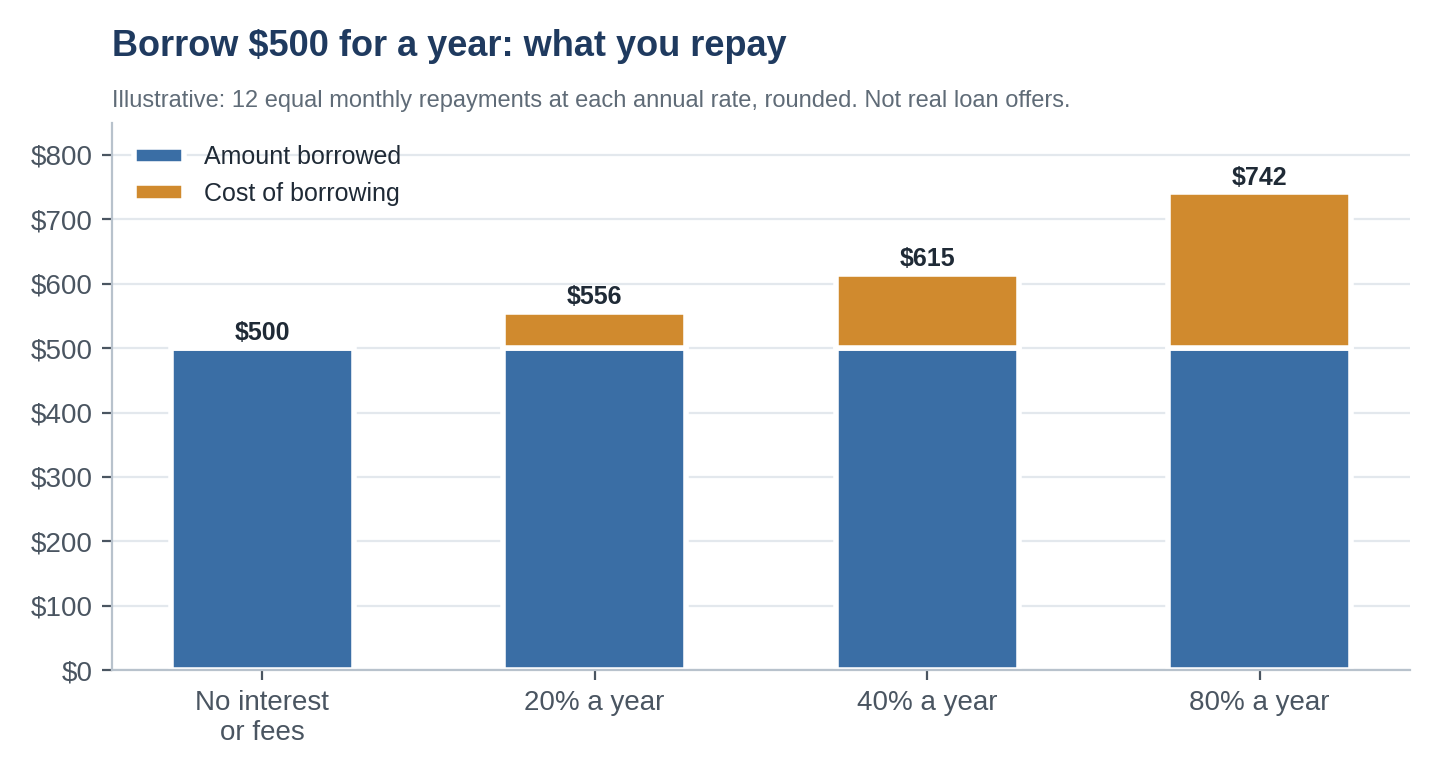
In this illustrative calculation, borrowing $500 for a year costs nothing with no interest, $56 at 20% a year, and $242 at 80% a year. The same laptop can cost very different amounts depending on how you pay for it.
Check:
If a lender won't tell you these things clearly, don't borrow from them.
BNPL can feel different from borrowing because it is quick and often interest-free if you pay on time. But it is still debt, and several small plans can quickly add up to more than you can repay.
Protections vary by country. For example, in the UK the Financial Conduct Authority began regulating BNPL on 15 July 2026. Lenders must now check whether you can afford to repay, tell you the amounts and any late fees before you agree, contact you if you miss a payment, and offer support if you struggle. You can also complain to the Financial Ombudsman Service. Check what applies where you live.
Informal loans are common and can be kind and interest-free. They also carry a risk to relationships. Protect both:
Many readers prefer to avoid interest for religious reasons. An interest-free loan made to help someone, often called qard hasan, is one example. Our guide to Islamic finance basics explains more.
If debt is becoming a problem, act early. Speak to lenders before you miss a payment; many are required to help, or have hardship options. Look for free, independent debt advice in your country. In the UK, for example, the government-backed MoneyHelper service points people to free debt advice. Universities often have student money advisers too.
Before agreeing to any loan, card or BNPL plan, write down the total you will repay and check it fits your budget. If you already have debts, list them all in one place: who you owe, how much, and when each payment is due.
Repayment figures are illustrative calculations, not loan offers.
| Source | Used for | Checked |
|---|---|---|
| Financial Conduct Authority: Buy Now Pay Later | UK BNPL regulation from 15 July 2026; affordability checks; pre-agreement information; missed-payment contact; Financial Ombudsman access; support in difficulty | 29 September 2026 |