Guide
Needs, wants and priorities: the foundation of every budget
3 min read · Beginner

Stipends paid once a term, family support that varies, freelance work that comes and goes: learn how to turn uneven money into a steady monthly plan, and stop the feast-and-famine cycle.
Most budgeting advice assumes a salary: the same amount, on the same day, every month. Many students and young professionals do not live like that. Your money might come from a stipend paid once a term, from family when they are able to send it, from freelance jobs, or from a small business.
Irregular income is not a problem in itself. The problem is the pattern it often creates: spending freely when money arrives, then struggling in the weeks before the next payment. This guide shows how to break that cycle.
Your baseline is the amount you can rely on in an ordinary month, not a good one.
Only count money you are sure of. Occasional extras, such as a one-off freelance job, are a bonus, not part of the baseline.
Build your monthly budget, as described in our guide to building your first budget, using only your baseline amount. Your needs and fixed commitments must fit inside it. If they do not, that is important information: it is better to find the gap now than in the last week of term.
This is the key habit. When money arrives, do not put it straight into your everyday spending.
The holding pot absorbs the ups and downs, so your spending stays steady.
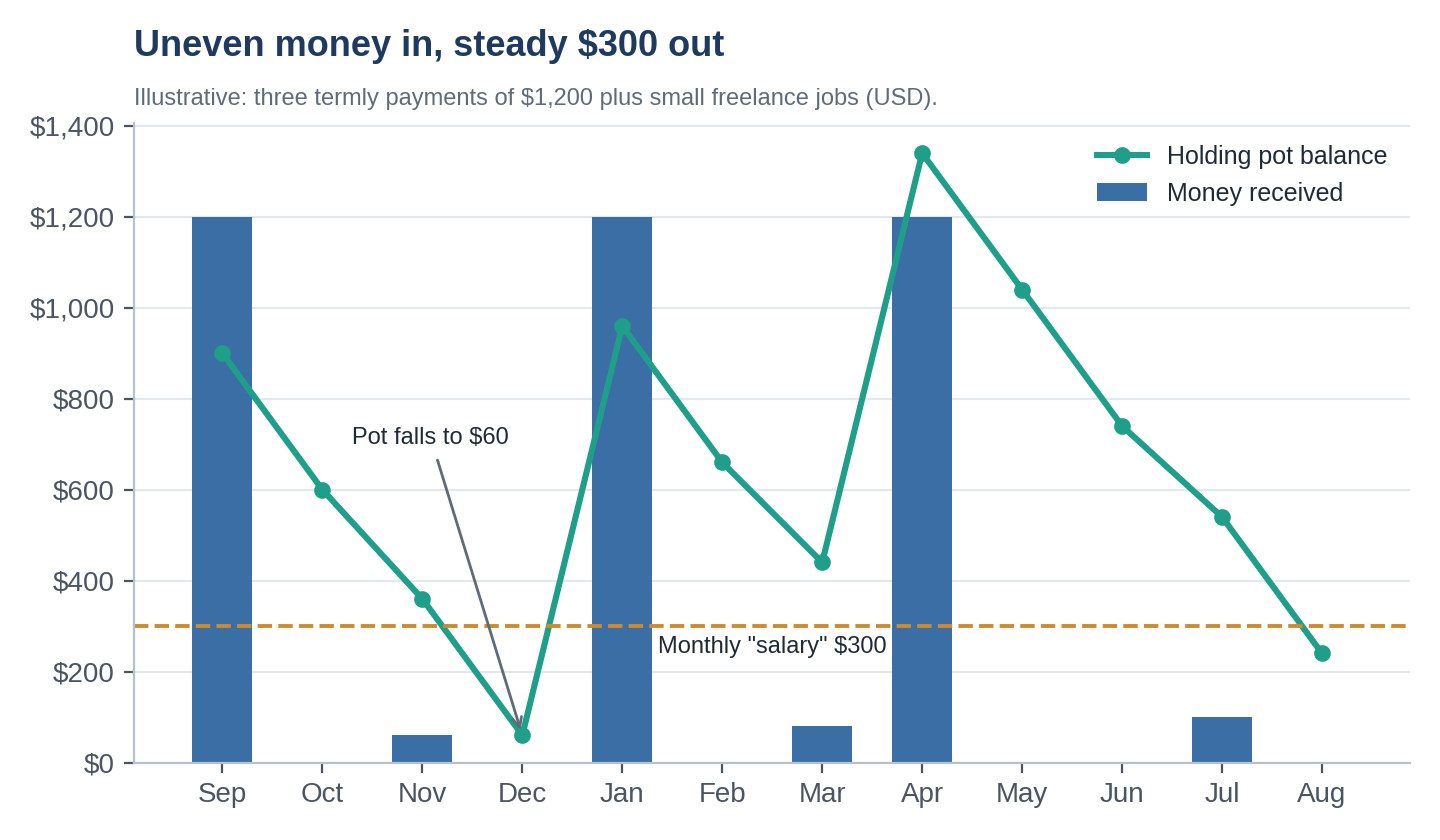
In this imaginary year, $3,840 arrives in uneven amounts but the student moves a steady $300 a month. Notice December: the pot falls to $60 before the January payment. That is why small extras should stay in the pot as a buffer rather than being spent straight away.
When you receive more than your baseline, decide its job before you spend it. A sensible order is:
If your family sends money when they can, talk openly about what they can realistically manage and when. A small amount they can send reliably is easier to plan with than a larger amount that arrives unpredictably.
Take the income you received over the last six months (or the terms of your stipend) and calculate your baseline month. Then open or choose a separate place to use as your holding pot before your next payment arrives.
This article gives general guidance and contains no time-sensitive facts, rules or figures, so no external sources are cited. All numbers are illustrative.