Guide
How to find scholarships you can actually apply for
5 min read · Beginner

"Fully funded" does not always mean every cost is paid. Learn to read an award line by line, spot the costs it leaves out, and work out how much you still need to find.
Winning a scholarship is a great achievement. But the headline can hide important details. Two awards that both sound generous can leave you with very different costs to cover. Before you accept an offer, or even before you apply, it pays to know exactly what the money is for.
There is no single official meaning of fully funded. Some awards pay tuition, living costs and flights. Others pay tuition and a living allowance, but not your visa or health charges. A few pay tuition only and still call themselves fully funded.
So treat "fully funded" as a description, not a promise. The real answer is always in the award's terms and conditions.
Most study costs fall into these groups:
Find the award's official terms and conditions, not a summary on a listing site. Then read slowly and look for these words:
Here is an imaginary first year costing $29,000 in total, and two imaginary awards.
| Cost (illustrative) | Total cost | Award A pays | Award B pays |
|---|---|---|---|
| Tuition | $18,000 | $18,000 | $9,000 (50%) |
| Living costs (12 months) | $8,400 | $8,400 stipend | Nothing |
| Return flights | $900 | $900 | Nothing |
| Visa and health charges | $1,000 | Nothing | Nothing |
| Insurance | $300 | Nothing | Nothing |
| Arrival and setting up | $400 | $400 one-off | Nothing |
| You still need to find | $1,300 | $20,000 |
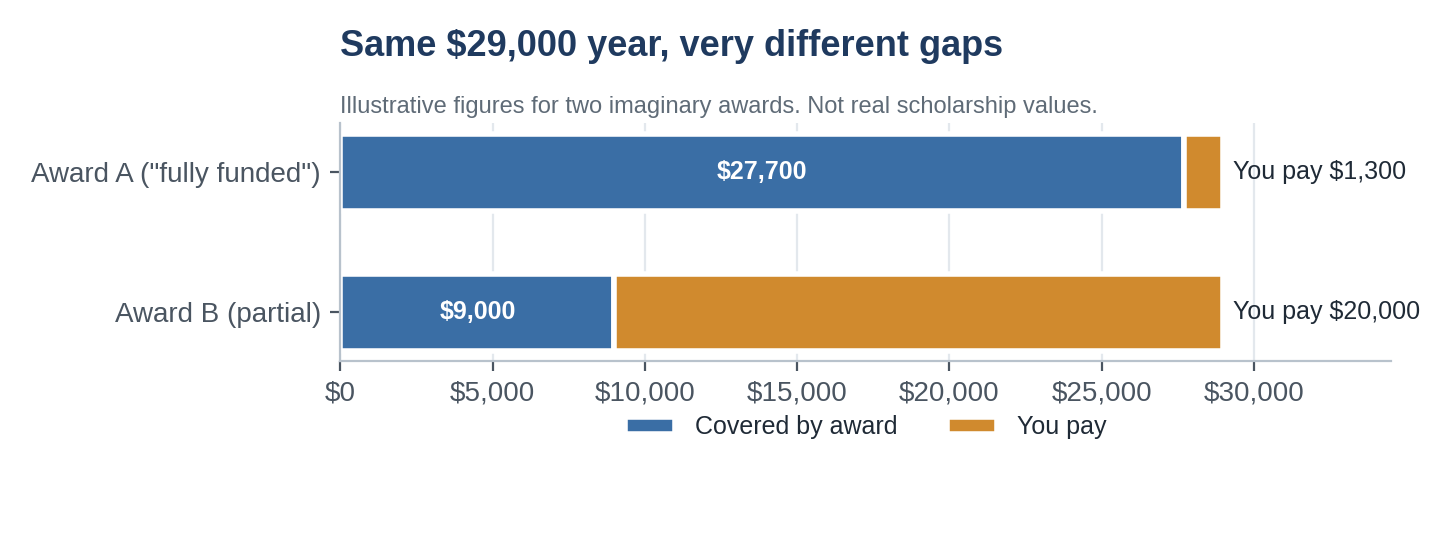
Award A describes itself as fully funded and covers most costs, but still leaves $1,300 to find, much of it before you travel. Award B is a valuable 50% tuition award, yet the student would need to find $20,000 more. Both could be good offers. Only one may be affordable.
Even when an award covers a cost, the money may not arrive when you need it.
Awards often have conditions. Common examples include studying full time, keeping satisfactory grades, not taking certain paid work, or returning to your home country after your studies. Some awards ask you to repay money if you withdraw. Read these conditions before you accept, and make sure you can keep to them.
Pick two awards you are interested in, or one award and your current plan. Copy the comparison table and fill in each line from the official terms. The bottom line is your funding gap. Our guide How to fund your university studies looks at ways to close it.
This article uses imaginary awards on purpose, so it stays accurate as real schemes change. It contains no time-sensitive facts about named schemes, so no external sources are cited. All figures are illustrative.