Guide
What a scholarship really pays for, and the gap it can leave
4 min read · Beginner

Stop scrolling through endless scholarship lists. Learn a simple five-step method to define what you need, search trusted sources, check eligibility properly and build a shortlist you can realistically apply to.
Search for "scholarships for Somali students" and you will find long lists, social media posts and websites promising "fully funded" places. Many look exciting. Far fewer will fit your situation.
The goal is not to find every scholarship in the world. It is to find the small number you are genuinely eligible for, that match your plans, and that you have time to apply to well. This guide gives you a five-step method to get there.
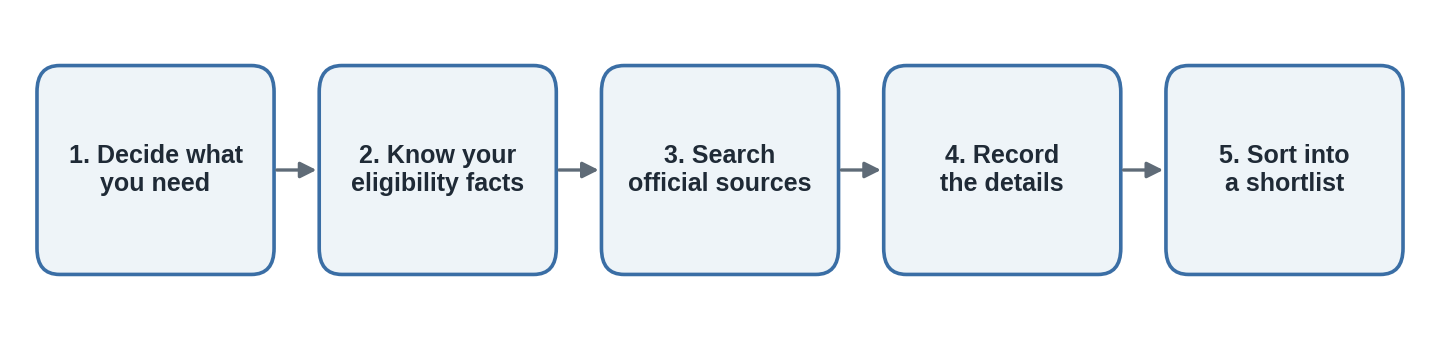
Each step removes opportunities that were never right for you, so you spend your energy where it counts.
Before you search, write down four things:
Most scholarships are tied to one study level, and often to certain subjects or countries. A clear starting point stops you reading about awards that were never meant for you.
Eligibility means the formal conditions you must meet before your application is even considered. If you do not meet them, a strong application will not change the result.
Gather these facts about yourself:
Why so much detail? Many schemes judge citizenship and residence separately, so the answer can differ for students in Somalia and in the diaspora.
Somalia and the diaspora: same heritage, different eligibility. Two examples, checked on the official websites in September 2026:
Rules change from year to year, so always read the current terms yourself.
Start with the organisations that actually provide the money or run the programme:
Scholarship listing websites, news pages and social media can help you discover names. Treat them as a starting point, not the final word. Copy the scholarship's name, find the provider's own page, and read the terms there.
For every promising opportunity, write down the same details. A notebook works; a spreadsheet is easier to sort.
| What to record | Why it matters |
|---|---|
| Name and provider | So you can find the official page again |
| Official link | Where you check the terms and apply |
| Study level and subjects | Confirms it matches Step 1 |
| Citizenship and residence rules | Often decides whether you can apply at all |
| Other conditions | Grades, work experience, age, language, commitments after study |
| What it pays for | Tuition, a stipend (a regular living allowance), flights, insurance |
| Linked steps | For example, needing a university offer by a set date |
| Opening date and deadline | Include the time and time zone |
| Date you checked | So you know when to check again |
Linked steps catch many applicants out. Chevening, for example, asks applicants to apply to three eligible UK courses and hold an unconditional offer by a set date.
Put every opportunity into one of three groups:
Expect your list to shrink sharply. That is the method working.
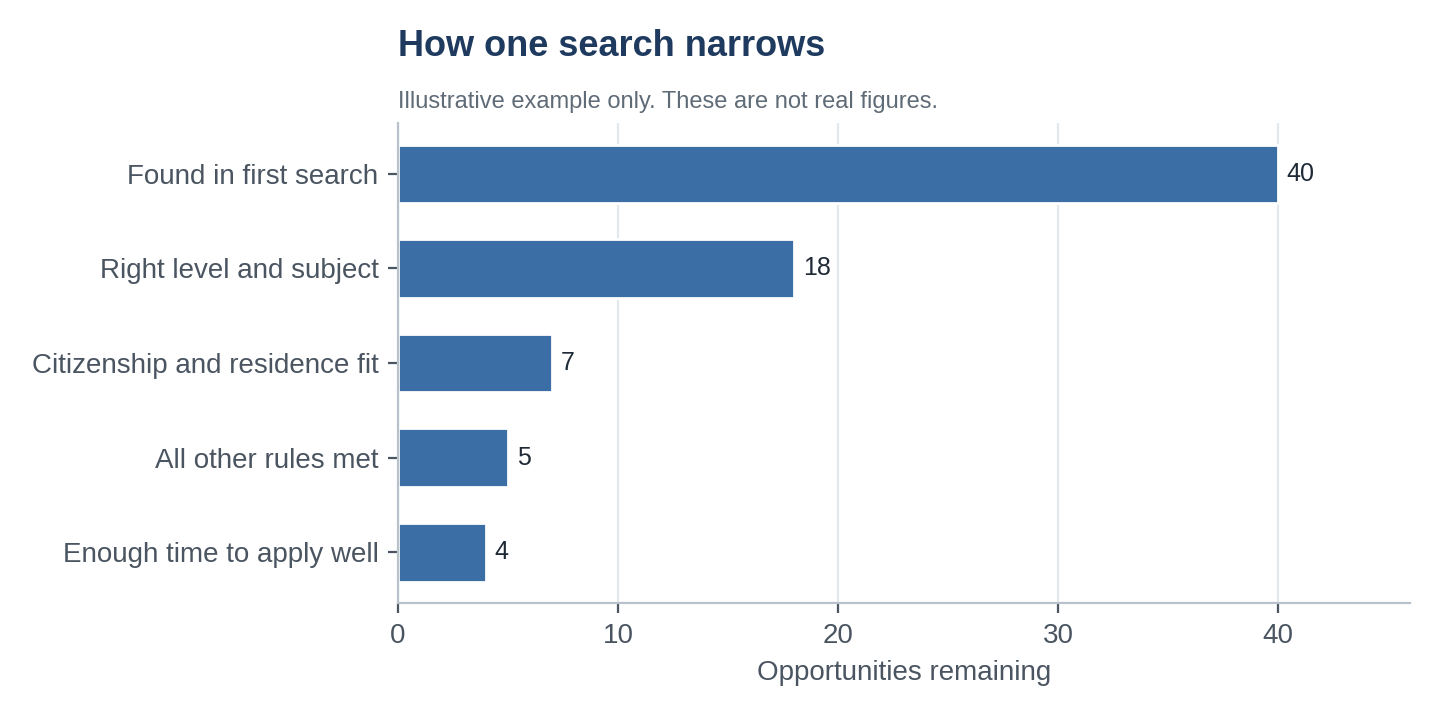
Aim for a shortlist of three to five opportunities: few enough to do each one well, and enough that no single decision settles everything.
Keep requirements and advice separate. A requirement, such as "two years' work experience after your degree", is fixed. Advice, such as "show leadership in your essay", may strengthen an application, but it will never make you eligible or ineligible.
Genuine providers publish their rules openly. Be cautious if anyone asks you to pay to be "selected", promises a guaranteed award, or contacts you from a personal email address. The EU agency that runs Erasmus Mundus states plainly that its scholarships are not granted for a fee.
All ten ticked? Put it in your Apply group. Any unclear answer belongs in Check further. Any clear "no" means Drop.
Set aside 30 minutes this week. Write down your study level, subject, destinations and start date, then find five scholarships from official sources that seem to fit. Run each one through the checklist above and keep the three to five that pass.
You can begin by exploring scholarships on Fursad Connect. Each listing links to the official source, so you can confirm the current terms before you apply.
In our next guide, Needs, wants and priorities, we look at how to decide what your money should pay for first.
All pages opened and checked on 25 September 2026.
| Source | Used for |
|---|---|
| Chevening: Somalia country page | Somalia is a Chevening-eligible country |
| Chevening: eligibility criteria | British and dual British citizens and UK residents cannot apply; two years' work experience; three UK course applications and an unconditional offer |
| Commonwealth Scholarship Commission: Commonwealth Master's Scholarships | Citizenship or refugee status plus permanent residence in an eligible country; Kenya is on the eligible list |
| Commonwealth Secretariat: member countries | Somalia is not a Commonwealth member |
| Erasmus+: Erasmus Mundus Joint Masters | Students from all over the world are welcome; apply directly to each programme |
| EACEA: scholarships page | Warning that EU scholarships are not granted for a fee; link to the Erasmus Mundus catalogue |
| British Council Study UK: scholarships and funding | Background: universities, government schemes and specialist sites as places to search |