Guide
How to find scholarships you can actually apply for
5 min read · Beginner

Sending money home is an act of care, and it deserves a plan. Learn how to build family support into your budget, talk honestly about what you can manage and keep transfer costs down.
For many Somali students and young professionals, supporting family is a natural part of life. Money sent home can pay for school fees, food, medicine or rent. It reflects values of care and responsibility that many readers are proud of.
Support works best when it is planned. Unplanned giving, however generous, can leave you short of rent, force you to borrow, or put your studies at risk. And a crisis for you helps no one at home.
Treat family support as a regular line in your budget, not something paid from whatever is left.
A smaller amount that arrives reliably is often more useful to a family than larger amounts that come unpredictably.
Family members may assume that anyone studying or working abroad has plenty of money. They may not know about rent, tuition, visa costs or rules limiting how much students can work.
It can help to:
These conversations can be hard. Being open is a form of respect, both for your family and for yourself.
Every transfer has two possible costs:
The only number that matters is how much your family actually receives for the amount you pay.
World Bank data shows how much costs vary. Across the world, sending $200 cost an average of 6.36% in the third quarter of 2025, or about $12.72. Sub-Saharan Africa was the most expensive region to send money to, at 8.46%.
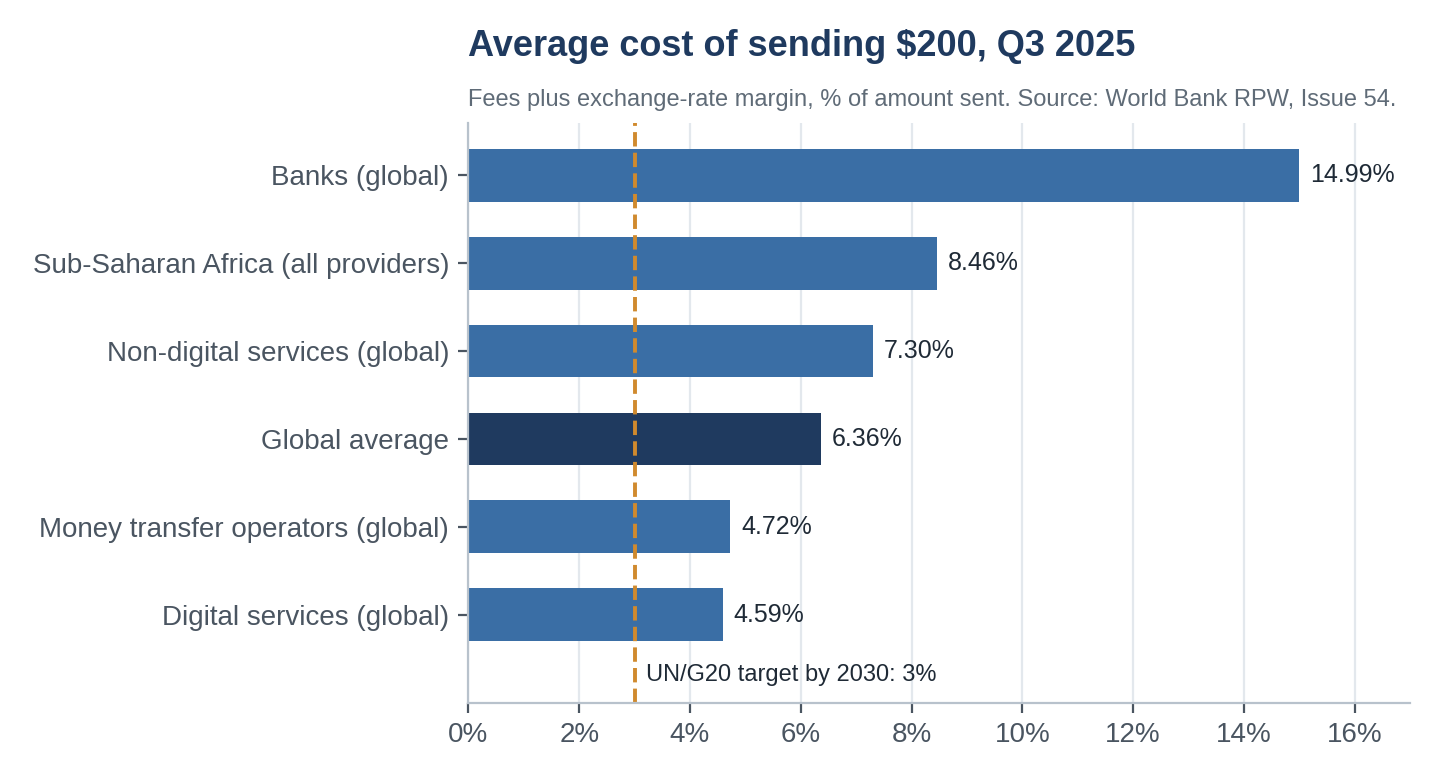
The type of service matters too. On average, banks were the most expensive way to send money, and digital services were among the cheapest. These are global averages, so check real prices for your own route.
| Question | Provider A | Provider B |
|---|---|---|
| Amount I pay (including fee) | ||
| Exchange rate offered | ||
| Amount my family receives | ||
| How quickly it arrives | ||
| How my family collects it | ||
| Is the provider licensed or registered? |
Add a family support line to your monthly budget, with an amount you can sustain. Next time you send money, compare two providers using the table above and choose the one that gets the most money to your family.
| Source | Used for | Checked |
|---|---|---|
| World Bank: Remittance Prices Worldwide, Issue 54 (September 2025) | Global average 6.36%; Sub-Saharan Africa 8.46%; banks 14.99%; money transfer operators 4.72%; digital 4.59%; non-digital 7.30%; 3% target by 2030 (Q3 2025 data) | 29 September 2026 |